How to Prepare an Old Book for Altering or Art Journaling
As an Amazon Associate I earn from qualifying purchases. Thank yous for your support!
Have y'all ever wanted to learn how to alter a book to turn it into an art journal? This post will share with yous the bones steps for how to prepare an old volume for art journaling.
It is very of import before altering a volume or using an old book for art journaling is properly preparing information technology before you start creating in information technology. While it takes some time and patience to exercise this, in the terminate information technology will definitely save you a lot of headaches and ensure your artistic work stays intact.
How to Alter an Old Book Step by Step
In this post I volition walk you through step past step my process of creating an art journal from an former book. 
Stride 1: Choosing the Right Books to Alter
Choosing the right blazon of old book to alter is the kickoff important step to take. While one would think that any former volume would do, you lot're going to want to look for one that has sewn binding as opposed to glued binding.
While very sometime, vintage books like the ones shown here might be cute, these types of books are not always the best candidates to use for altering, at to the lowest degree non using the same technique the way I share here. Very sometime antique books will likely demand a little reinforcement and more advanced book binding techniques in order to be something that is sturdy.
The Near Important Thing When Altering a Volume? Sewn Bounden
Most books volition either accept sewn binding or glued binding. Glued binding is exactly what it sounds like – the pages are glued together. This is pretty common for virtually mass-market books printed in the by xxx years, even if they are a hardcover book. Nevertheless, you do non want glued binding for your altered book projects if you tin can avert it! Sewn bounden is stronger and the pages will be less probable to autumn out, whereas with glued bounden you lot risk the glue coming autonomously and pages falling out. It is relatively easy to identify sewn binding in an old book you lot want to change – y'all will see actual stitches in between the signatures of the book!  What is a signature? Signatures are sections of pages, and then you might come across the stitches in betwixt every twenty-40 pages or and then for case, depending on the volume of course! Annotation: Some books this does non apply to – such as children'south board books.
Need Some Inspiration For What Types of Books to Utilize?
You can use many different kinds of books for your contradistinct book projects! Hither are some ideas for dissimilar types of old books you lot can use:
- Children'due south books
- Hardback fiction books
- Textbooks
- Cookbooks
- Dwelling & Garden Books
Equally you tin can see, there all sorts of different types of books to use for you to larn how to alter a book for fine art journaling! The possibilities are endless! Also think about the size of the book – practise y'all desire a big fat book with many pages or maybe a large skinny children's volume with plenty of room on each page as your canvas?
Where to Find Sometime Books for Altering into Fine art Journals Free or Cheap:
Finding onetime books can be a challenge. Fortunately y'all can often find them for less than a few dollars each book. Here are some of the places I've been successful in finding them:
- Public & Private Library Book Sales in my surface area
- Flea Markets and M/Garage Sales
- Thrift Stores
- Craigslist
- eBay (try to find local sellers almost you to avert high aircraft costs for heavy books!)
- Used Bookstores such equally Half Priced Books and others
- Ask Family unit & Friends for onetime books you tin can buy from them
Want to see how I shop for books and the types of books I similar to get? Read This: How I Find Mixed Media Art Supplies At Used Book Sales. In one case you have your books, you're gear up to beginning preparing it for altering and making into an fine art journal!
Pace ii: Commencement Ripping Out the Pages of the Old Book if Necessary
 Something I've learned with experience if you will be using the book for an art journal is that you lot may want to do is rip out at to the lowest degree one-half of the pages in the book. This may audio scary, simply information technology will give yous a LOT more than room and flexibility subsequently in the projection! So, if you have a 30 page book, you lot will plough it into a 15 page one. Why on globe would we do this? The main reason for this is considering when you start painting on your pages, and glue stuff to them, information technology makes the book much thicker than the binding can handle. And so, get ripping away! Of course, you do not actually take to "rip" the pages out – y'all can always apply a craft knife and carefully cutting these pages out. That sometimes looks a lot neater and nicer. I commonly salvage my ripped out pages for gluing and collaging later on in the fine art journal, so these pages don't even get wasted. Any leftovers are simply used for making junk journals!
 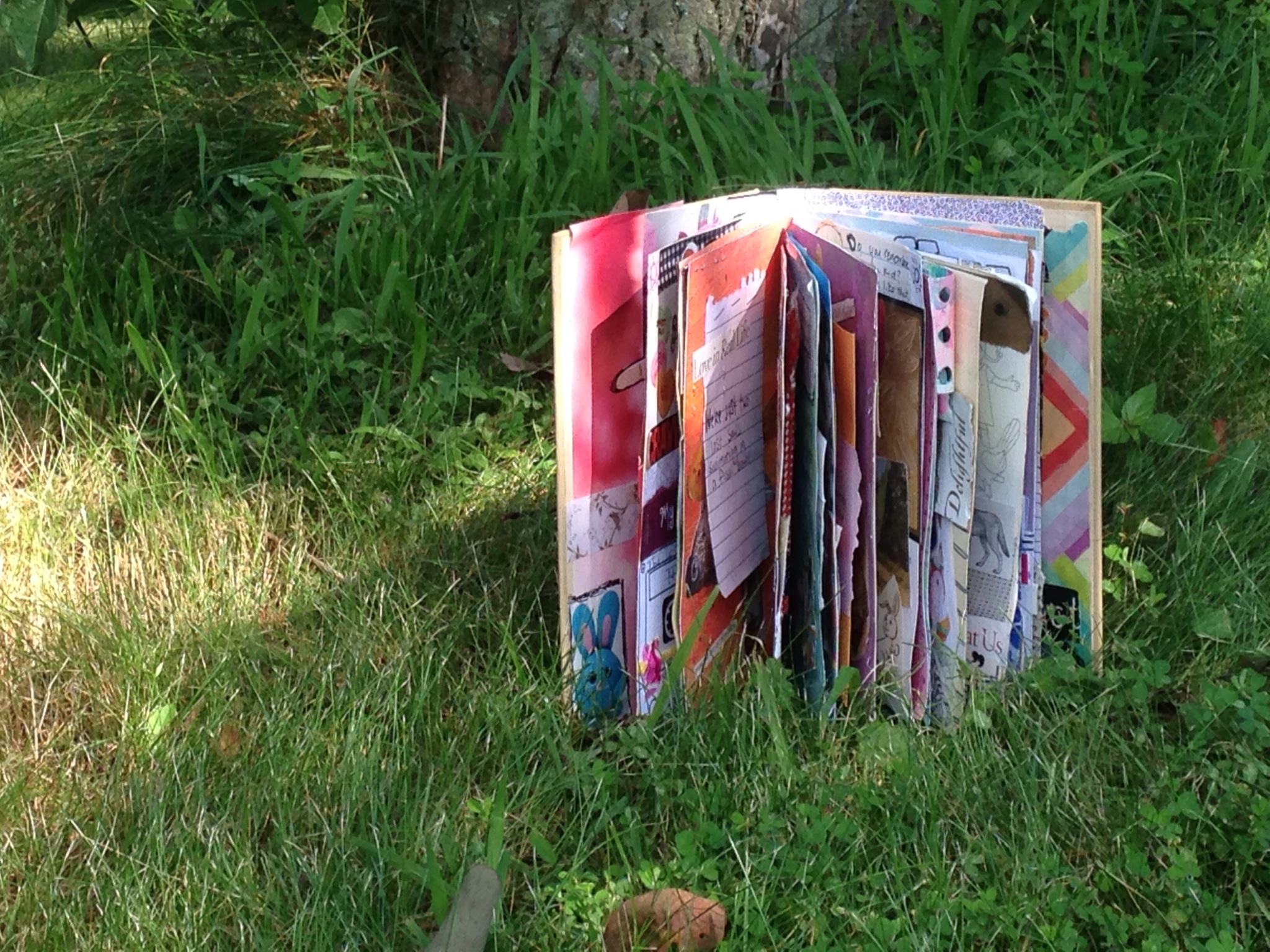 You may have dissimilar preferences and experiences than I have had with this – a lot volition as well depend on your style of creating art periodical pages. I am very heavy on the collage layers, so for me information technology makes sense. Feel gratis to experiment with what works best for you and your style – The important thing is that the volume's binding will be able to hold up to the thickness of the volume.
Pace 3: Glue the Pages Together if Necessary
 Depending on the paper weight of the pages in your book, y'all will probably want to glue some of the pages together to make for a stronger and heavier page. I typically will utilise a heavy duty glue stick for this step when I make an altered book. Be certain to put a little extra on the corners as that is where they are about likely to come apart at. You can glue 1-ii pages together or several, depending on the weight of the paper in the book. Gluing your pages together will probable cause some rippling and bumpiness in the page, but no one said art journaling had to be perfect. If the bumpiness and wrinkling bothers you, you can besides choose to apply more collage elements and avoid the paint and wet media all together if the pages are sparse.
Step iv: Priming Pages With Gesso
This step is completely optional, simply is usually a "must-exercise" for me, as I dear working with Gesso – it really does assistance the acrylic paint stick a fleck improve to the page. The main reason I use gesso withal is because I usually cull some odd books for turning into journals and don't commonly desire all the words and titles and folio numbers showing through! This is from our altered composition book tutorial – you lot tin see the Gesso does a very proficient chore of covering things upwards – sometimes too good of a task! 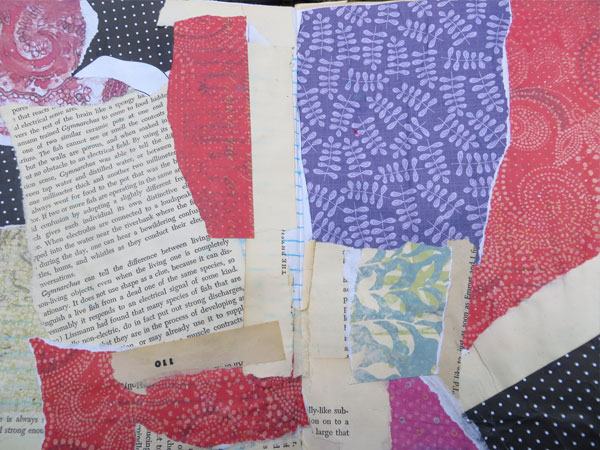
 Not sure what Gesso is? Gesso is a white primer bachelor at most craft and hobby stores. You tin also notice information technology online or if in a real pinch, become downwards to the local hardware store and buy a small pint of white primer – while not quite the same that will work too!
Now You're Ready to Create in Your Altered Volume!
Once the pages are ripped out, glued together, and the gesso has stale, you are ready to start creating in your new altered volume! This is the really fun function of using an old volume as an fine art journal! I hope you find this tutorial on how to create an altered volume helpful, and of course, if you take whatever questions about how to start an fine art journal, share your questions in the comments department beneath or join u.s. in our Facebook Community Group to connect with others!
quintanarhasky1983.blogspot.com
Source: https://artjournalist.com/how-to-prepare-an-old-book/
0 Response to "How to Prepare an Old Book for Altering or Art Journaling"
Post a Comment